I've spent a great deal of refreshing time off line in the last 10 days while practicing for and singing in the Temple Beth El choir for the High Holy Days. That detox was really needed, especially given how ugly things have become recently.
I'm one of those people who always reads the footnotes and the acknowledgements when I read books, and when I'm in synagogue I'm no different - some of the most interesting stuff about the Torah is found in the commentary. This quote about ritual in the High Holy day machzor really struck a chord with me:
"Ritual fills the human need for completeness. It speaks to the depth of human emotion by giving a specific form to work through diverse emotions."
This resonated with me on so many levels. Firstly, as the parent of a kid who grew up on the autistic spectrum, I know how important ritualistic behavior can be for dealing with emotions like anxiety, anger, insecurity, even happiness.
But it's not just for those on the AS. Go through the experience of losing both of my parents in rapid succession, Dad to the long, slow, painful goodbye of Alzheimer's and Mom to the sudden, unexpected and no change to say goodbye of a DVT, made me appreciate how humane and necessary the rituals of shiva and mourning in the Jewish faith are to dealing with grief. Shiva, while exhausting, reminds you that you are not alone in your grief, that you are loved, and that you have community to support you. In the case of my dad, where I'd only been allowing myself to remember my dad as he was at that very moment during the Alzheimer's descent, because thinking about him as he was before was too painful, shiva was a time where we all could start to reconnect back with "real Dad" - the one we'd started to lose so many years before. We put together a slideshow that played throughout of pictures of him throughout his life and it gave us a chance to talk about him and tell stories and remember the man we missed so much and had been missing so much all through the Alzheimer's journey.
With Mom, her death was so sudden and unexpected, and came so soon on the heels of losing Dad, that the grief felt like it was bottomless and never-ending. But I had children, book deadlines and a mortgage and health insurance to pay. I couldn't let myself give into the grief. I had to get up and persist - as one does. But the grief was there, always. The ritual of going to synagogue to say kaddish for a year was healing because it meant that I wasn't just allowed, but prescribed to recognize that I was still mourning, even though I was still having to pick myself up and get on with life, because that's what you do.
On certain Jewish holidays, there's the Yizkor service, in which we remember those who have passed on before us. In Orthodox Congregations, they ask everyone whose parents are still living to leave. Because I'd been attending an orthodox congregation before my parents died, I'd never been in a Yizkor service until after my father died. I remember the Yom Kippur service very shortly before Dad died. I'd spent Kol Nidre with him instead of going to services, and I knew he wasn't going to make it until the following year. When my son and I went outside for Yizkor, I started crying and I said to my son, "This is the last time I'm going to be outside for Yizkor." And it was.
Now I attend a conservative synagogue and I realized yesterday as I was crying my way through the beautiful Yizkor service that there were young kids in the room and that people hadn't been asked to leave if their parents were alive. I was talking to my husband about it this morning, and we both thought how much healthier it is. Sure, kids might get scared by seeing their parents cry, but they also realize that mourning people you love is natural and part of life - and that it's okay to cry. I remember when I was at Silver Hill, and I told the psychiatrist that I always cried in the shower because I didn't want my kids to see me cry. He said: "What's the matter with letting them see you cry?"
That was one of the "aha" moments when I realized that it was okay to be human, not "perfect".
There are so many different kinds of ritual that can provide comfort - they don't necessarily have to be religious. But there is comfort and meaning in ritual - especially when community is a part of it.
If my doctor told me I had only six minutes to live, I wouldn't brood. I'd type a little faster. ~Isaac Asimov
Showing posts with label Dad. Show all posts
Sunday, October 1, 2017
Saturday, May 21, 2016
Speech: Ferguson Library Friends Literary Awards, April 17 2016
I constantly joke with my kids that you’re never a hero in your own hometown. But after today I’m going to have to stop saying that, because being asked to speak as an author at the Ferguson Library where I spent so many hours growing up, makes me feel like I am a hero. So I’d like to start off by thanking you for this incredible honor and privilege.
I’m a passionate supporter of public libraries, and especially the amazing librarians who work in them. Librarians made me writer. But just as importantly – or perhaps even more importantly, they helped to make me a thinker.
When it comes to literacy I confess that I started life on first base – maybe even on second. That’s because I was born into a family of readers and a home filled with books. But even within my family, I had a voracious appetite for the written word – I was the kid in the family who was kept getting caught under the covers reading with a flashlight when I was supposed to be asleep.
To satisfy my book cravings, Mom brought us to the library every week and I got to pick out a new stack to bring home. One reason why I feel fortunate to have grown up when I did rather than now is that, I never, ever, had a librarian, parent, or teacher say “Sorry, Sarah that book is above your Lexile level.” The grownups in my life just kept handing me interesting, challenging, books and I kept on reading them.
If I didn’t know the meaning of words – and I often didn’t – I learned to figure them out from the context of the sentence or if I really got stuck I’d ask my parents. But Mom and Dad never answered my question directly. Instead they’d point me to the “Shorter” Oxford English Dictionary and tell me to look it up. Now here’s some insight into the way my brain works. As I was writing this I suddenly thought: I wonder how much that thing weighed? So I went and got it off the shelf and put it on my kitchen scale. This sucker weighs almost 9lbs – imagine having to haul that around when you were a little kid wanting to know the meaning of a word.
Living in the social media age, I then felt compelled to tweet how much the Shorter OED weighs because the people who follow me on my author account would probably be interested in that kind of thing. And Robin Powell, a childhood friend of mine from England saw the picture and sent me back a picture of the Shorter Oxford English Dictionary my parents had given him for his Bar Mitzvah in January 1973. In the flyleaf was an inscription written by my father: “It’s never winter in the land of HOPE and it’s never dull in a dictionary. Use this book a lot and reap its rewards.”
My father died two and half years ago after a long journey with Alzheimers, so seeing what he’d written 43 years ago made me pretty emotional. But it also made me realize that this apple didn’t fall far from the tree.
I was curious about the phrase “It’s never winter in the land of Hope” and I wondered if it was from a book. So I Googled it and it turns out it’s a Russian proverb. What’s interesting about that is my Grandpa Harry, who died when I was 11, was from the Ukraine, and so I wonder now if it’s a proverb my father heard from his father.
One of the things we lose with e-books is discovering these kinds of gifts from the past in books. But that’s not the only thing we lose with technology. When my parents made me look up a word in the dictionary, in the process I’d inevitably find other interesting words on the page around the word I was looking up, and so I’d end up further developing my vocabulary and love of language. By just entering the one word you don’t know in a web browser and getting the definition in seconds, you lose the magic of doing that.
I was also fortunate because my parents never censored my reading. They put the so-called “inappropriate books” on the top shelf, but they also always had a set of library steps in the room so that we could get to those books on our own when we were old enough to be curious.
I followed this strategy with my own kids. When my daughter Amie was in middle school, the film version of Alice Sebold’s book “The Lovely Bones” came out, and most of her friends were reading it. Amie asked me if we had it – which we did, because I’d read it many years before, and then wanted to know if she could read it.
I didn’t say no. What I did was discuss the book with her. I told her it was a thought provoking book and well written, but the first chapter was very upsetting to read. Because she had nightmares sometimes, I worried that it might be too much for her so my advice would be to wait a year or two. But I told her that I would leave the decision up to her, and if she really felt like she wanted to read it, the book was on the shelf, hers for the taking. She took my advice and waited.
That’s why I get very angry when parents try to censor books for other people’s children or ban books from school libraries. What they are doing is abdicating their own job as parents. It’s all about the conversations we have. Different kids are ready for different books at different times, and that’s why trained librarians are so incredibly important, both in our public libraries and in our public schools.
It’s thanks to librarians that I Journeyed to the Center of the Earth, went 20,000 Leagues under the Sea and Around the World in 80 Days with Jules Verne. It’s thanks to librarians that I solved the mystery of the Hound of the Baskervilles with Sir Arthur Conan Doyle. Because of librarians I went from wealth to poverty and back again like A Little Princess and discovered a Secret Garden with Francis Hodgson Burnett. Because of librarians I asked G-d if he was there and discovered how to improve my bust with Judy Blume.
Not long after my first book, CONFESSIONS OF A CLOSET CATHOLIC, came out, I met Judy Blume at the memorial service for my mentor, the late Paula Danziger.. I wanted to tell her how much she inspired me, not just because of her writing, but because of her passionate advocacy against censorship. The problem was I literally, couldn’t talk. 12 year old Sarah inside was like: “OMG OMG – I’M STANDING 18 INCHES AWAY FROM JUDY FREAKING BLUME!”
It just goes to show that even middle-aged authors can be utter and complete fangirls.
I knew I wanted to be a writer when I was in high school, but I didn’t try to write a book until I was almost forty. Even thought my parents always acknowledged that I was a talented writer, I was given the same message back in the late 70’s that I hear constantly from politicians and business leaders today: “You’ll never make a living as an English major.” So even though writing was what I loved, and literature was my passion, I majored in political science and got an MBA in Finance. I worked on Wall Street as a financial analyst, until I met my kids’ dad and moved to a small village in Dorset, England where by marrying I doubled the Jewish population (and by having Josh and Amie tripled and quadrupled it). I put my MBA to use by managing the finances of the family’s dairy farming and cheese making enterprise. If you want to know about the lactation yield curve of a dairy cow, I’m your girl, but in the 17 years I’ve lived in Greenwich it’s never once come up at a cocktail party.
But all along, a voice inside kept saying “I want to write.” I ignored it, because I was doing the things that everyone expected me to do: making a living, being a good daughter, a good wife, and a good mother. It wasn’t till I was hospitalized for a nervous breakdown at age 38 that I realized I didn’t want to end up in a nursing home at the end of my life thinking, “What would have happened if?” I was so busy being an overachiever that it took all my bricks falling down to finally give me the clarity I needed to build myself up in a stronger way. I knew then that I had to give myself the chance to pursue my long held dream of being a writer, even if I failed, because I’d rather have tried and failed than never have tried at all.
The good news is that I didn’t fail. Since that hospitalization in 2001, when I finally gave myself permission to write, I’ve written fifteen books, eight in my own name and seven under a pseudonym. I get emails from readers all over the United States and from abroad, too – my books have been translated into German, Greek and soon, Serbian.
When you get emails from teenagers saying: “I really loved your book, like more than I love the world! It felt like you described my whole life” or simply “Thank you for helping me,” - well let’s just say it’s so much more pleasant and rewarding than the comments I get from grown ups on my political columns. The emails I get from my teen readers remind me why it’s worth fighting every day to try to make the world a better place, even on the days when the hateful comments I’m getting from adults make it especially hard to be courageous.
I’m going to finish up with a few pieces of advice based on the things I’ve learned from my long, circuitous and somewhat unconventional journey to doing what I have no doubt is my G-d given purpose in life.
The first is something I learned from my father, and that’s to always be aware of what is going on in the world around you. Inspiration is everywhere, but you have to be paying attention.
The second is something I learned from my mother and that’s to be a good listener. Writers are like sponges – constantly listening to the people and ideas and dialogue, because we never know when something might be useful for a book.
The third is from me – and that’s don’t ever lose your curiosity. Writing is the perfect career for me because it’s lifelong learning. Each of my books begins with a question, which I start off by researching. One of the best parts of my job is that I get to interview really interesting people about what they do as part of the research process. Some people I’ve interviewed include a supervisory special agent at the FBI in New Haven, an emergency room doctor, a talent agent, a Catholic priest, the senior Naturalist and education specialist at Greenwich Audubon, an employment lawyer, and the head of the Special Victims section at Greenwich police. Using the information I learn from my research, I then create situations where my characters can help me work through the answer to the question I want to answer in the book.
But the most important piece of advice if you want to be a writer comes from Jane Yolen, who’s an incredibly prolific and successful author, as well as being the first cousin once removed of Stamford resident and travel writer, Malerie Yolen-Cohen. I heard Jane speak at a writing conference about ten years ago and the best advice she gave was: “Get your butt in the chair and write the damn book.”
Because in the end that’s what makes the difference between me and the people I meet at cocktail parties who tell me “Oh, I’d write a novel if I only had the time.” The difference is that I made the time. I wrote in doctor’s office waiting rooms and carpool lines while waiting to pick up my kids. I wrote late at night after spending the day doing freelance business writing, and early in the morning before I had to take the kids to school. I wrote when I didn’t feel inspired and when I was convinced that what I was writing was total rubbish – and it probably was. But that rubbish helped me write better rubbish and eventually I wrote something good enough to get published.
And now, all these years and fifteen books later, I’m standing here giving a speech in the library where I worked on papers in high school and dreamed about being a writer. Thank you, thank you, from the bottom of my heart for giving me this honor. What I’m really looking forward to is the day in the future, when I’m in the audience listening to one of you giving this speech as the featured author. So make sure you get your butt in the chair and write that book.
I’m a passionate supporter of public libraries, and especially the amazing librarians who work in them. Librarians made me writer. But just as importantly – or perhaps even more importantly, they helped to make me a thinker.
When it comes to literacy I confess that I started life on first base – maybe even on second. That’s because I was born into a family of readers and a home filled with books. But even within my family, I had a voracious appetite for the written word – I was the kid in the family who was kept getting caught under the covers reading with a flashlight when I was supposed to be asleep.
To satisfy my book cravings, Mom brought us to the library every week and I got to pick out a new stack to bring home. One reason why I feel fortunate to have grown up when I did rather than now is that, I never, ever, had a librarian, parent, or teacher say “Sorry, Sarah that book is above your Lexile level.” The grownups in my life just kept handing me interesting, challenging, books and I kept on reading them.
If I didn’t know the meaning of words – and I often didn’t – I learned to figure them out from the context of the sentence or if I really got stuck I’d ask my parents. But Mom and Dad never answered my question directly. Instead they’d point me to the “Shorter” Oxford English Dictionary and tell me to look it up. Now here’s some insight into the way my brain works. As I was writing this I suddenly thought: I wonder how much that thing weighed? So I went and got it off the shelf and put it on my kitchen scale. This sucker weighs almost 9lbs – imagine having to haul that around when you were a little kid wanting to know the meaning of a word.
Living in the social media age, I then felt compelled to tweet how much the Shorter OED weighs because the people who follow me on my author account would probably be interested in that kind of thing. And Robin Powell, a childhood friend of mine from England saw the picture and sent me back a picture of the Shorter Oxford English Dictionary my parents had given him for his Bar Mitzvah in January 1973. In the flyleaf was an inscription written by my father: “It’s never winter in the land of HOPE and it’s never dull in a dictionary. Use this book a lot and reap its rewards.”
My father died two and half years ago after a long journey with Alzheimers, so seeing what he’d written 43 years ago made me pretty emotional. But it also made me realize that this apple didn’t fall far from the tree.
I was curious about the phrase “It’s never winter in the land of Hope” and I wondered if it was from a book. So I Googled it and it turns out it’s a Russian proverb. What’s interesting about that is my Grandpa Harry, who died when I was 11, was from the Ukraine, and so I wonder now if it’s a proverb my father heard from his father.
One of the things we lose with e-books is discovering these kinds of gifts from the past in books. But that’s not the only thing we lose with technology. When my parents made me look up a word in the dictionary, in the process I’d inevitably find other interesting words on the page around the word I was looking up, and so I’d end up further developing my vocabulary and love of language. By just entering the one word you don’t know in a web browser and getting the definition in seconds, you lose the magic of doing that.
I was also fortunate because my parents never censored my reading. They put the so-called “inappropriate books” on the top shelf, but they also always had a set of library steps in the room so that we could get to those books on our own when we were old enough to be curious.
I followed this strategy with my own kids. When my daughter Amie was in middle school, the film version of Alice Sebold’s book “The Lovely Bones” came out, and most of her friends were reading it. Amie asked me if we had it – which we did, because I’d read it many years before, and then wanted to know if she could read it.
I didn’t say no. What I did was discuss the book with her. I told her it was a thought provoking book and well written, but the first chapter was very upsetting to read. Because she had nightmares sometimes, I worried that it might be too much for her so my advice would be to wait a year or two. But I told her that I would leave the decision up to her, and if she really felt like she wanted to read it, the book was on the shelf, hers for the taking. She took my advice and waited.
That’s why I get very angry when parents try to censor books for other people’s children or ban books from school libraries. What they are doing is abdicating their own job as parents. It’s all about the conversations we have. Different kids are ready for different books at different times, and that’s why trained librarians are so incredibly important, both in our public libraries and in our public schools.
It’s thanks to librarians that I Journeyed to the Center of the Earth, went 20,000 Leagues under the Sea and Around the World in 80 Days with Jules Verne. It’s thanks to librarians that I solved the mystery of the Hound of the Baskervilles with Sir Arthur Conan Doyle. Because of librarians I went from wealth to poverty and back again like A Little Princess and discovered a Secret Garden with Francis Hodgson Burnett. Because of librarians I asked G-d if he was there and discovered how to improve my bust with Judy Blume.
Not long after my first book, CONFESSIONS OF A CLOSET CATHOLIC, came out, I met Judy Blume at the memorial service for my mentor, the late Paula Danziger.. I wanted to tell her how much she inspired me, not just because of her writing, but because of her passionate advocacy against censorship. The problem was I literally, couldn’t talk. 12 year old Sarah inside was like: “OMG OMG – I’M STANDING 18 INCHES AWAY FROM JUDY FREAKING BLUME!”
It just goes to show that even middle-aged authors can be utter and complete fangirls.
I knew I wanted to be a writer when I was in high school, but I didn’t try to write a book until I was almost forty. Even thought my parents always acknowledged that I was a talented writer, I was given the same message back in the late 70’s that I hear constantly from politicians and business leaders today: “You’ll never make a living as an English major.” So even though writing was what I loved, and literature was my passion, I majored in political science and got an MBA in Finance. I worked on Wall Street as a financial analyst, until I met my kids’ dad and moved to a small village in Dorset, England where by marrying I doubled the Jewish population (and by having Josh and Amie tripled and quadrupled it). I put my MBA to use by managing the finances of the family’s dairy farming and cheese making enterprise. If you want to know about the lactation yield curve of a dairy cow, I’m your girl, but in the 17 years I’ve lived in Greenwich it’s never once come up at a cocktail party.
But all along, a voice inside kept saying “I want to write.” I ignored it, because I was doing the things that everyone expected me to do: making a living, being a good daughter, a good wife, and a good mother. It wasn’t till I was hospitalized for a nervous breakdown at age 38 that I realized I didn’t want to end up in a nursing home at the end of my life thinking, “What would have happened if?” I was so busy being an overachiever that it took all my bricks falling down to finally give me the clarity I needed to build myself up in a stronger way. I knew then that I had to give myself the chance to pursue my long held dream of being a writer, even if I failed, because I’d rather have tried and failed than never have tried at all.
The good news is that I didn’t fail. Since that hospitalization in 2001, when I finally gave myself permission to write, I’ve written fifteen books, eight in my own name and seven under a pseudonym. I get emails from readers all over the United States and from abroad, too – my books have been translated into German, Greek and soon, Serbian.
When you get emails from teenagers saying: “I really loved your book, like more than I love the world! It felt like you described my whole life” or simply “Thank you for helping me,” - well let’s just say it’s so much more pleasant and rewarding than the comments I get from grown ups on my political columns. The emails I get from my teen readers remind me why it’s worth fighting every day to try to make the world a better place, even on the days when the hateful comments I’m getting from adults make it especially hard to be courageous.
I’m going to finish up with a few pieces of advice based on the things I’ve learned from my long, circuitous and somewhat unconventional journey to doing what I have no doubt is my G-d given purpose in life.
The first is something I learned from my father, and that’s to always be aware of what is going on in the world around you. Inspiration is everywhere, but you have to be paying attention.
The second is something I learned from my mother and that’s to be a good listener. Writers are like sponges – constantly listening to the people and ideas and dialogue, because we never know when something might be useful for a book.
The third is from me – and that’s don’t ever lose your curiosity. Writing is the perfect career for me because it’s lifelong learning. Each of my books begins with a question, which I start off by researching. One of the best parts of my job is that I get to interview really interesting people about what they do as part of the research process. Some people I’ve interviewed include a supervisory special agent at the FBI in New Haven, an emergency room doctor, a talent agent, a Catholic priest, the senior Naturalist and education specialist at Greenwich Audubon, an employment lawyer, and the head of the Special Victims section at Greenwich police. Using the information I learn from my research, I then create situations where my characters can help me work through the answer to the question I want to answer in the book.
But the most important piece of advice if you want to be a writer comes from Jane Yolen, who’s an incredibly prolific and successful author, as well as being the first cousin once removed of Stamford resident and travel writer, Malerie Yolen-Cohen. I heard Jane speak at a writing conference about ten years ago and the best advice she gave was: “Get your butt in the chair and write the damn book.”
Because in the end that’s what makes the difference between me and the people I meet at cocktail parties who tell me “Oh, I’d write a novel if I only had the time.” The difference is that I made the time. I wrote in doctor’s office waiting rooms and carpool lines while waiting to pick up my kids. I wrote late at night after spending the day doing freelance business writing, and early in the morning before I had to take the kids to school. I wrote when I didn’t feel inspired and when I was convinced that what I was writing was total rubbish – and it probably was. But that rubbish helped me write better rubbish and eventually I wrote something good enough to get published.
And now, all these years and fifteen books later, I’m standing here giving a speech in the library where I worked on papers in high school and dreamed about being a writer. Thank you, thank you, from the bottom of my heart for giving me this honor. What I’m really looking forward to is the day in the future, when I’m in the audience listening to one of you giving this speech as the featured author. So make sure you get your butt in the chair and write that book.
Wednesday, July 1, 2015
Dads of Daughters: This is how you do it
Ever since Mom passed away suddenly and unexpectedly in March, we've been going through her apartment, trying to get the place ready for sale. Mom saved everything. EVERYTHING.
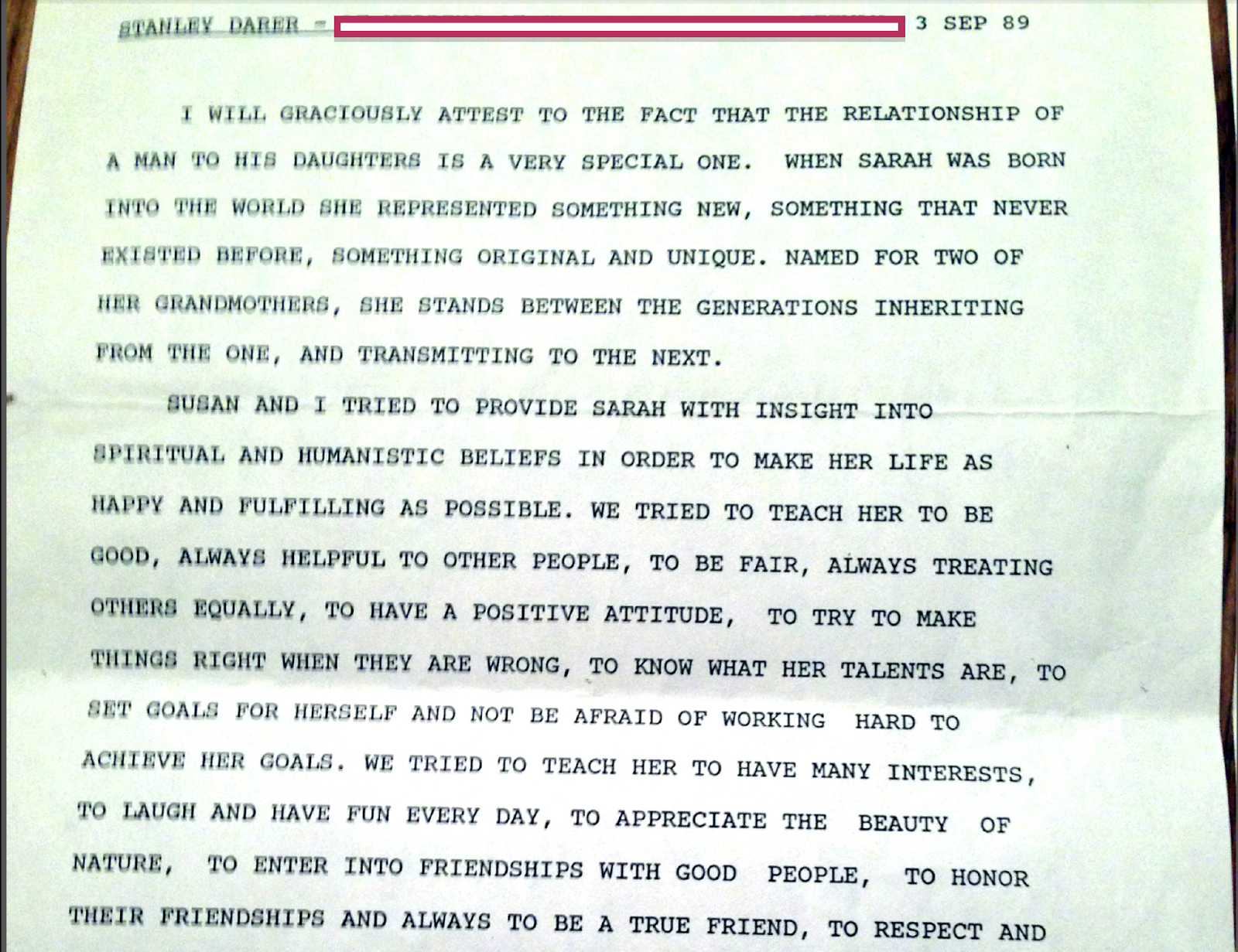
Today I found the speech that my father gave at my wedding. Of course, I heard it before, on Sept 3rd, 1989, but that was a long time ago, and I was pretty overwhelmed with emotions on the day. I remember crying at the time, but today when I found it, I cried again for completely different reasons. My father died in November 2013, but even before that he had lost the incredible intelligence and way with words that made him the man he was to Alzheimer's. But not the love for us. He never lost that. His eyes always lit up when he saw us, even if he didn't remember our names.
Finding this speech brought my father back to me and made me miss him all over again. But it also reminded me of how much of who I am is because of who he and Mom were. If I am brave, it was because Dad and Mom were brave. If I have the courage to stand up for what is right, it is because he and Mom were courageous.
If I have now found the love and support of a good man who respects my intelligence, it is because my father deeply loved my mother and respected her intelligence.
Fathers of daughters: This is how you do it.
Wednesday, April 22, 2015
Dear Teenagers - Some advice from my late Dad...via me
My dearest teens. You know I love you. I really do. That's why I write books for you, and love to answer your emails. So that's why I'm writing this post. Because I care.
I subscribe to several daily news, business and tech email blasts to keep me informed for my "other life" as a columnist - and also because I'm interested in what's going on in the world. It helps me to be a better writer and a more interesting person.
This morning, to my horror, in an email blast that calls itself Business Insider "Tech Select," these were the first three stories:
Relegated to "other news" were stories about how Tesla is building batteries for use in buildings and how Facebook's Ad service affects businesses. But the first three stories were about teenagers (that's you, my dears) doing this viral challenge to have have plump lips with dangerous and painful results.
After my first thought, which was to be mad at the alleged grown ups at alleged "Tech Select" for the ridiculous way they are prioritizing "news", I started hearing the voice of this guy in my head:
That's Dad and me, the day I graduated from college. Sadly, Dad passed away in November 2013 after a long struggle with Alzheimer's, but I still hear the things he said to me, the advice he gave me, as clearly as if he were standing right next to me like he was in this photo.
And when I saw those headlines, I heard his voice saying something he so often asked me when I was a teenager: "If all your friends jumped off a cliff, would you do it, too?"
I'm sure many of my similarly aged friends heard something to that effect from one or the other of their parents, and were as sick of hearing it as I was.
But there is wisdom in them there cliches, my dears. Trust your Auntie Sarah on this.
I get it. You are trying to figure out your identity. You want to be heard. And there's so much pressure today to be SEEN.
I'm old. Or as my daughter would say, "OOOOOOOOOOOOOOOLD." We didn't have things like Instagram and Facebook and YouTube when I was a teen. Heck, we didn't even have the Internet. We didn't have cellphones. So we didn't have to worry about how many followers we had or how many likes we got, or if we could get our YouTube video to go viral, because there wasn't a YouTube and viral was something associated with a disease you didn't want to get.
But here's the thing. I was in a video that did go viral. This one. It's had over 1.1 million hits on YouTube.
Yet that conversation didn't go viral because my son and I went into the StoryCorps booth with the intention of creating something viral. We didn't even know it would be on NPR Morning Edition. We didn't even know that it would be turned into an animation. We didn't know, when we walked into that booth, that one day we would be on Good Morning America. We never thought for a moment that because of it we would be on our very first red carpet:
We certainly hadn't the slightest idea that one day we would be in the front row at the TED Conference when Dave Isay, the founder of StoryCorps, and winner of the 2015 TED Prize, announced his Wish for the World.
All of those incredibly amazing experiences happened because my son and I went into the StoryCorps booth with the sole intention of having a genuine, honest conversation with each other - of making a loving, human connection. And we did that. Even if none of the other things had happened, we would have achieved what we set out to do.
The rest is gravy. Really exciting and wonderful gravy, and I am so grateful for all of the experiences we have come out of this. I also continue to be amazed by how this conversation connects with people from all over the world, no matter their nationality, race or religion.
That's what's important, my dears. Not having plump lips. Not looking like anyone else. Being the best YOU that you can be and making human connections.
So please, I beg you - the next time you think about doing one of these ridiculous challenges, just remember my dear old Dad and pick up a book instead. You'll thank me later. I promise.
Thursday, November 7, 2013
SORROW FLOATS: Eulogy for my father – STANLEY P. DARER
delivered at Temple Beth El, Wednesday November 6th, 2013
I wouldn’t be the woman I am today if not for the influence of our father, Stanley Paul Darer – Schmaria Pesach ben Aaron v Malka
A critical part becoming a good writer is learning to be good reader. My father was a voracious reader who modeled to us, his children, that not moment of time that could be devoted to reading should be wasted - not even when sitting on the throne doing one’s business.
We always had a wide range of reading material available everywhere in our house, including the bathroom, which is where I got my start reading Foreign Affairs. Dad’s taste’s ran heavily towards spy novels, for obvious reasons, as well as autobiographies, and historical non-fiction.
Dad taught us the importance of learning from history – something I wish more politicians would learn. As kids, we’d snuggle up in our PJ’s watching the amazing BBC documentary series The World at War with him. He was way before his time with “reality TV” – except there was nothing lighthearted or prurient about this variety.
But Dad wasn’t always serious. He loved the absurd, too and we’d laugh together watching Monty Python and Benny Hill.
Dad was like that – quick to anger, but equally quick to laughter.
He taught us we should observe, and more importantly that we should care about what was going on in the world around us.

He also taught us, by his example, to be good citizens who engaged in public service. But as we got older and started developing our own points of view, we didn’t always agree on the direction of that public service. When my political views started to diverge from Dad’s, the arguments at family get togethers could get loud and quite spectacular, as my children Josh and Amie can attest.
Losing Dad to Alzheimer’s has been a slow, painful grieving process – I compare it to having your heart cut out with a butter knife. I hate the disease for robbing me of conversations I wanted to have with Dad, for robbing Josh and Amie of more time with their beloved Grandpoo, and for stealing the chance for Dylan, Daniel and Hank to get to know Papa and Dad as he really was. But as painful as it’s been for all of us, there have been moments of grace and humor, and even some lessons that living with this for the last ten years has taught me.

I learned that being open and giving to others eases your pain, too. I’d bring our dog Benny to visit Dad, with whom he had a very special relationship. If Dad was having a bad day and I felt sad, taking Benny to visit the other residents and seeing the smiles he brought to their faces made me feel better. Benny and I have made so many friends at Waveny that we’re planning to go for official therapy dog training so we can continue our visits.
Perhaps the most important lesson I’ve learned from Dad’s condition is to live more in the present. I’m Jewish, and a Mother, which (funnily enough) makes me a Jewish Mother, and if that weren’t enough qualification for being a total worry wort, I’ve fought depression and anxiety since I was a teenager. When I went to visit Dad I had to learn to go with the flow - to meet him wherever he happened to be that day. Sometimes it was the past, but mostly it was the present. We’d hold hands, listen to music, enjoy walking Benny, and just being together. The last time my father said coherent words to me, he smiled, kissed my hand and said, “You’re wonderful.” He might not have remembered my name, or even that I was specifically his daughter, but he remembered his love all of us up to the very end.

And that’s the other really important thing I’ve learned from this long and painful journey. I’ve been to weddings of Christian friends, and always loved Paul’s letter to the Corinthians. I’ve thought of it often these last few years: “But now faith, hope, love, abide these three; but the greatest of these is love.” Dad didn’t remember my name, but his face still lit up when he saw me. Love is the greatest of these, and it’s what has supported us all and helped us get through this difficult time.
One vacation when I was home from college, Dad was reading The Hotel New Hampshire by John Irving. He drove me crazy because he’d start cracking up while he was reading and then he’d insist on reading the passage that made him laugh aloud. They were mainly about Sorrow, the Labrador, “a fetcher and farter”. I think Sorrow tickled his funny bone because we also had a Labrador – (Winnie, named after Winston Churchill) who could be rather flatulent himself.
I finally begged Dad to stop because I wanted to read the book myself. Like I said, Dad was great at modeling reading – and, pretty good at book talking, too.
But when he finally handed me the book, my father didn’t warn me about the sad bit - the part that made me cry so much when I got to it that I had to put the book down for the rest of the day to recover before I could continue reading.
Dad taught us how to drive, he taught us really inappropriate jokes, he taught us patriotism and the importance of casting our vote, he taught us to respect the office of the President even if you don’t agree with the man in that office. He taught me that I should always drink alcohol more slowly than any guy who took me out on a date. When I was going through my divorce, he came to Chabad every Shabbat to sit next to my son and help him prepare for his Bar Mitzvah.
But here’s the thing - Dad knew that we had to discover for ourselves that Sorrow Floats.
And even though we’ve had so long to prepare for this, even though we thought we were prepared, the shock of turning the page and learning that lesson, that Sorrow Floats, is just as devastating now as it was when I read the Hotel New Hampshire, all those years ago. But this time, I can’t go and talk to Dad about it, which only makes it more so.
STANLEY PAUL DARER
1934-2013
This is one of our favorite family pictures of Dad because it is so him - how many people would go for a camel ride in the desert in a coat and tie? But it was so very, very Dad.
I wouldn’t be the woman I am today if not for the influence of our father, Stanley Paul Darer – Schmaria Pesach ben Aaron v Malka
A critical part becoming a good writer is learning to be good reader. My father was a voracious reader who modeled to us, his children, that not moment of time that could be devoted to reading should be wasted - not even when sitting on the throne doing one’s business.
We always had a wide range of reading material available everywhere in our house, including the bathroom, which is where I got my start reading Foreign Affairs. Dad’s taste’s ran heavily towards spy novels, for obvious reasons, as well as autobiographies, and historical non-fiction.
Dad taught us the importance of learning from history – something I wish more politicians would learn. As kids, we’d snuggle up in our PJ’s watching the amazing BBC documentary series The World at War with him. He was way before his time with “reality TV” – except there was nothing lighthearted or prurient about this variety.
But Dad wasn’t always serious. He loved the absurd, too and we’d laugh together watching Monty Python and Benny Hill.
Dad was like that – quick to anger, but equally quick to laughter.
He taught us we should observe, and more importantly that we should care about what was going on in the world around us.

He also taught us, by his example, to be good citizens who engaged in public service. But as we got older and started developing our own points of view, we didn’t always agree on the direction of that public service. When my political views started to diverge from Dad’s, the arguments at family get togethers could get loud and quite spectacular, as my children Josh and Amie can attest.
Losing Dad to Alzheimer’s has been a slow, painful grieving process – I compare it to having your heart cut out with a butter knife. I hate the disease for robbing me of conversations I wanted to have with Dad, for robbing Josh and Amie of more time with their beloved Grandpoo, and for stealing the chance for Dylan, Daniel and Hank to get to know Papa and Dad as he really was. But as painful as it’s been for all of us, there have been moments of grace and humor, and even some lessons that living with this for the last ten years has taught me.

I learned that being open and giving to others eases your pain, too. I’d bring our dog Benny to visit Dad, with whom he had a very special relationship. If Dad was having a bad day and I felt sad, taking Benny to visit the other residents and seeing the smiles he brought to their faces made me feel better. Benny and I have made so many friends at Waveny that we’re planning to go for official therapy dog training so we can continue our visits.
Perhaps the most important lesson I’ve learned from Dad’s condition is to live more in the present. I’m Jewish, and a Mother, which (funnily enough) makes me a Jewish Mother, and if that weren’t enough qualification for being a total worry wort, I’ve fought depression and anxiety since I was a teenager. When I went to visit Dad I had to learn to go with the flow - to meet him wherever he happened to be that day. Sometimes it was the past, but mostly it was the present. We’d hold hands, listen to music, enjoy walking Benny, and just being together. The last time my father said coherent words to me, he smiled, kissed my hand and said, “You’re wonderful.” He might not have remembered my name, or even that I was specifically his daughter, but he remembered his love all of us up to the very end.

And that’s the other really important thing I’ve learned from this long and painful journey. I’ve been to weddings of Christian friends, and always loved Paul’s letter to the Corinthians. I’ve thought of it often these last few years: “But now faith, hope, love, abide these three; but the greatest of these is love.” Dad didn’t remember my name, but his face still lit up when he saw me. Love is the greatest of these, and it’s what has supported us all and helped us get through this difficult time.
One vacation when I was home from college, Dad was reading The Hotel New Hampshire by John Irving. He drove me crazy because he’d start cracking up while he was reading and then he’d insist on reading the passage that made him laugh aloud. They were mainly about Sorrow, the Labrador, “a fetcher and farter”. I think Sorrow tickled his funny bone because we also had a Labrador – (Winnie, named after Winston Churchill) who could be rather flatulent himself.
I finally begged Dad to stop because I wanted to read the book myself. Like I said, Dad was great at modeling reading – and, pretty good at book talking, too.
But when he finally handed me the book, my father didn’t warn me about the sad bit - the part that made me cry so much when I got to it that I had to put the book down for the rest of the day to recover before I could continue reading.
Dad taught us how to drive, he taught us really inappropriate jokes, he taught us patriotism and the importance of casting our vote, he taught us to respect the office of the President even if you don’t agree with the man in that office. He taught me that I should always drink alcohol more slowly than any guy who took me out on a date. When I was going through my divorce, he came to Chabad every Shabbat to sit next to my son and help him prepare for his Bar Mitzvah.
But here’s the thing - Dad knew that we had to discover for ourselves that Sorrow Floats.
And even though we’ve had so long to prepare for this, even though we thought we were prepared, the shock of turning the page and learning that lesson, that Sorrow Floats, is just as devastating now as it was when I read the Hotel New Hampshire, all those years ago. But this time, I can’t go and talk to Dad about it, which only makes it more so.
STANLEY PAUL DARER
1934-2013
This is one of our favorite family pictures of Dad because it is so him - how many people would go for a camel ride in the desert in a coat and tie? But it was so very, very Dad.
Tuesday, August 20, 2013
I'm Walking for Alzheimers - in honor of Dad
I've written about my father and how painful it is losing him to Alzheimer's in previous posts here. I describe it to people has having my heart cut out with a butter knife. It's slow. It's painful.
But it's not without moments of beauty and love. My father has always been a dog person. We were rarely without a dog growing up, and although he could be very strict with us, my dad was a complete marshmallow when it came to dogs. Dogs know these things. By the time I got Benny in early 2008, Dad was already fading. But they established a very strong bond.
Fortunately, the Waveney Care Center ,where Dad lives now, is brilliant about allowing family members to bring in pets. Benny,despite having been turned down as an official therapy dog as a puppy because he couldn't maintain a sit/stay for long enough, is a regular visitor and has developed quite the fan club. What's even more amazing to me is that he's learned which residents are real dog people and makes a beeline for them as soon as we walk in the door.
But it's my father he's most excited to see. We have to go up in the elevator, and Benny knows exactly where to go:
As you can see from the pictures below, when he gets there, the love is mutual. Even if Dad is sleeping or agitated, Benny brings a smile to his face.
But Alzheimer's is a one way street, unfortunately, and Dad's condition has deteriorated since last year at this time. He is even more confused, and once when I went to visit him he'd forgotten how to pet Benny - I had to take Dad's hand and remind him how to stroke Benny's soft coat with his palm. It was heartbreaking.
And then there are what I call the tragicomic moments - the ones I am saving up for the adult novel I plan to write some day when I have some distance from all of this. Like when I went to visit Dad and I think he thought I was my mother (because I look like my mom) and told me he just wanted me to kiss him all day.
I was like, "Um, Dad, I'm your daughter. Folks tend to frown on that kind of thing."
Figuring I better get him to a more populated area, I walked him to the elevator. I'd just thrown on a sundress, and I guess it showed a little more cleavage than I usual. And we're in the elevator and I see that's where Dad is staring. And one part of my brain, the teenage part is like, "OMFG, my DAD IS STARING AT MY BOOBS!! I AM TOTALLY FREAKING OUT!!!!" and another part of my brain, the writer part, is thinking "This is going to make a hilarious scene in a book someday" and the third part of my brain, the rational part, is like, "This isn't going to end well" and sure enough, Dad lunges at me and I'm like "DAD! You can't DO THAT! I'm YOUR DAUGHTER!" at which point he looks all sheepish and gives me a cute grin and I can't be mad at him because it's Alzheimer's Dad, not Dad Dad and really, this IS going to make a great scene in my novel some day but OMG, teenage me is still freaking out because her dad just made a pass at her in the elevator.
Or the times when he gets agitated and reverts back to his time working in the intelligence service. "Did you see the men with the guns?" He'll ask me. I've learned to just meet him where he is. "I've scanned the area, Dad, and it's all secure now. But it's safe because of you. Great job of being on the look out."
I try to find the humor in it, but that's because I have to in order to stay sane. There is nothing funny about this disease. I hate it with a passion. It is evil and heartbreaking, and it has robbed me of conversations I want to have with my father, ones I kick myself for not having before.
That is why I'm once again participating in the Walk for Alzheimer's. If you are able to support our team at any level, I will be extremely grateful.
Here's where to donate: http://act.alz.org/site/TR/Walk/CT-Connecticut?px=6866996&pg=personal&fr_id=3300
But it's not without moments of beauty and love. My father has always been a dog person. We were rarely without a dog growing up, and although he could be very strict with us, my dad was a complete marshmallow when it came to dogs. Dogs know these things. By the time I got Benny in early 2008, Dad was already fading. But they established a very strong bond.
Fortunately, the Waveney Care Center ,where Dad lives now, is brilliant about allowing family members to bring in pets. Benny,despite having been turned down as an official therapy dog as a puppy because he couldn't maintain a sit/stay for long enough, is a regular visitor and has developed quite the fan club. What's even more amazing to me is that he's learned which residents are real dog people and makes a beeline for them as soon as we walk in the door.
But it's my father he's most excited to see. We have to go up in the elevator, and Benny knows exactly where to go:
As you can see from the pictures below, when he gets there, the love is mutual. Even if Dad is sleeping or agitated, Benny brings a smile to his face.
But Alzheimer's is a one way street, unfortunately, and Dad's condition has deteriorated since last year at this time. He is even more confused, and once when I went to visit him he'd forgotten how to pet Benny - I had to take Dad's hand and remind him how to stroke Benny's soft coat with his palm. It was heartbreaking.
And then there are what I call the tragicomic moments - the ones I am saving up for the adult novel I plan to write some day when I have some distance from all of this. Like when I went to visit Dad and I think he thought I was my mother (because I look like my mom) and told me he just wanted me to kiss him all day.
I was like, "Um, Dad, I'm your daughter. Folks tend to frown on that kind of thing."
Figuring I better get him to a more populated area, I walked him to the elevator. I'd just thrown on a sundress, and I guess it showed a little more cleavage than I usual. And we're in the elevator and I see that's where Dad is staring. And one part of my brain, the teenage part is like, "OMFG, my DAD IS STARING AT MY BOOBS!! I AM TOTALLY FREAKING OUT!!!!" and another part of my brain, the writer part, is thinking "This is going to make a hilarious scene in a book someday" and the third part of my brain, the rational part, is like, "This isn't going to end well" and sure enough, Dad lunges at me and I'm like "DAD! You can't DO THAT! I'm YOUR DAUGHTER!" at which point he looks all sheepish and gives me a cute grin and I can't be mad at him because it's Alzheimer's Dad, not Dad Dad and really, this IS going to make a great scene in my novel some day but OMG, teenage me is still freaking out because her dad just made a pass at her in the elevator.
Or the times when he gets agitated and reverts back to his time working in the intelligence service. "Did you see the men with the guns?" He'll ask me. I've learned to just meet him where he is. "I've scanned the area, Dad, and it's all secure now. But it's safe because of you. Great job of being on the look out."
I try to find the humor in it, but that's because I have to in order to stay sane. There is nothing funny about this disease. I hate it with a passion. It is evil and heartbreaking, and it has robbed me of conversations I want to have with my father, ones I kick myself for not having before.
That is why I'm once again participating in the Walk for Alzheimer's. If you are able to support our team at any level, I will be extremely grateful.
Here's where to donate: http://act.alz.org/site/TR/Walk/CT-Connecticut?px=6866996&pg=personal&fr_id=3300
Monday, May 27, 2013
Music, Memory and Alzheimers
One of the many things I love about my MidLifeCrisisMobile is Sirius Radio, because sometimes when I'm listening to Deep Tracks, Classic Vinyl or Classic Rewind, a song will come on and boom, I'm taken to another time and place. It happened yesterday when I was on the way back from visiting my dad at his assisted living facility - "Fat Man in the Bathtub" by Little Feat came on and I was suddenly back at Duke, sitting on the little balcony above the doorway at Wilson House, the one you had to climb out of the bathroom window of my suite to access, drinking beers and watching people hang out and play frisbee on the East Campus quad.
(Note, this is not a song where you have to ask for "More Cowbell". It is freaking Cowbelltastic.)
A month or so ago, I heard this song, which I had on vinyl but hadn't listened to since 1989 when I moved to England and last owned a turntable:
Even though I hadn't heard it over twenty years, I still remembered all the words. I asked my social network friends the question: Why do I remember the lyrics to a song I haven't heard in over twenty years, but I can't remember what I ate for breakfast?
I was thinking about this yesterday when I went to visit Dad. He was pretty out of it when I arrived. His circadian rhythms are reversed, so he spends a lot of the night walking the floors, and then is sleepy during the day. When Benny and I arrived for our visit, it took Benny a lot of face and hand licking to wake him up, and when he did wake up, he was very groggy. Downstairs, they were having the weekly singalong, so I encouraged Dad to get up and come for a walk with us so we could go join in. He held his head when he stood up, and because he can't articulate what he is feeling, we (his family and the staff) have to work together to figure it out from his past medical history and the clues he gives us). Are his medications affecting his blood pressure, causing him dizziness? Does he have a headache? It's like a giant guessing game, where the patient can't tell you if you have the right answer. All you can do is watch and observe and see if he looks happier and more comfortable.
We went to join the singing, and Dad sat quite happily with Benny on his lap, and was even happier after my brother John joined us.
The songs they sing are mostly from the 40's and 50's. "Smoke gets in Your Eyes." "As Time Goes Bye" "The Tennessee Waltz" "I love you truly, dear" (which always makes me verkempt, because my Grandma Mollie, Dad's mom, who also ended up with Alzheimer's, used to sing it to us).
Yesterday, I witnessed one of the ladies, who usually smiles at me but never speaks, get totally excited and talkative when her favorite song came up. She sang, loudly and not particularly tunefully, but it didn't matter. She was responding, and it was beautiful to see her face light up and to witness how it was the music that had touched some memory deep within her and turned on the switch.
I turned to my brother and asked, "What songs do you think they'll play when it's our turn?"
And I had this vision of myself, my wrinkled face lighting up, shouting "BISMILLAH, NO! WE WILL NOT LET HIM GO! LET HIM GO!!" as my middle aged children cringe. Or maybe, by then, they'll just be happy that Mom remembers, and sing along with me.
(Note, this is not a song where you have to ask for "More Cowbell". It is freaking Cowbelltastic.)
A month or so ago, I heard this song, which I had on vinyl but hadn't listened to since 1989 when I moved to England and last owned a turntable:
Even though I hadn't heard it over twenty years, I still remembered all the words. I asked my social network friends the question: Why do I remember the lyrics to a song I haven't heard in over twenty years, but I can't remember what I ate for breakfast?
I was thinking about this yesterday when I went to visit Dad. He was pretty out of it when I arrived. His circadian rhythms are reversed, so he spends a lot of the night walking the floors, and then is sleepy during the day. When Benny and I arrived for our visit, it took Benny a lot of face and hand licking to wake him up, and when he did wake up, he was very groggy. Downstairs, they were having the weekly singalong, so I encouraged Dad to get up and come for a walk with us so we could go join in. He held his head when he stood up, and because he can't articulate what he is feeling, we (his family and the staff) have to work together to figure it out from his past medical history and the clues he gives us). Are his medications affecting his blood pressure, causing him dizziness? Does he have a headache? It's like a giant guessing game, where the patient can't tell you if you have the right answer. All you can do is watch and observe and see if he looks happier and more comfortable.
We went to join the singing, and Dad sat quite happily with Benny on his lap, and was even happier after my brother John joined us.
The songs they sing are mostly from the 40's and 50's. "Smoke gets in Your Eyes." "As Time Goes Bye" "The Tennessee Waltz" "I love you truly, dear" (which always makes me verkempt, because my Grandma Mollie, Dad's mom, who also ended up with Alzheimer's, used to sing it to us).
Yesterday, I witnessed one of the ladies, who usually smiles at me but never speaks, get totally excited and talkative when her favorite song came up. She sang, loudly and not particularly tunefully, but it didn't matter. She was responding, and it was beautiful to see her face light up and to witness how it was the music that had touched some memory deep within her and turned on the switch.
I turned to my brother and asked, "What songs do you think they'll play when it's our turn?"
And I had this vision of myself, my wrinkled face lighting up, shouting "BISMILLAH, NO! WE WILL NOT LET HIM GO! LET HIM GO!!" as my middle aged children cringe. Or maybe, by then, they'll just be happy that Mom remembers, and sing along with me.
Subscribe to:
Posts (Atom)